Loading…
Recovery guide
Red light therapy — what the evidence supports, and what it doesn't
Red light therapy has real published evidence behind a few uses, skin, certain kinds of healing, possibly muscle recovery, and much weaker support for most of what it's marketed for. Here's the claim-by-claim breakdown, so you know what a session can plausibly do before you pay for a package.
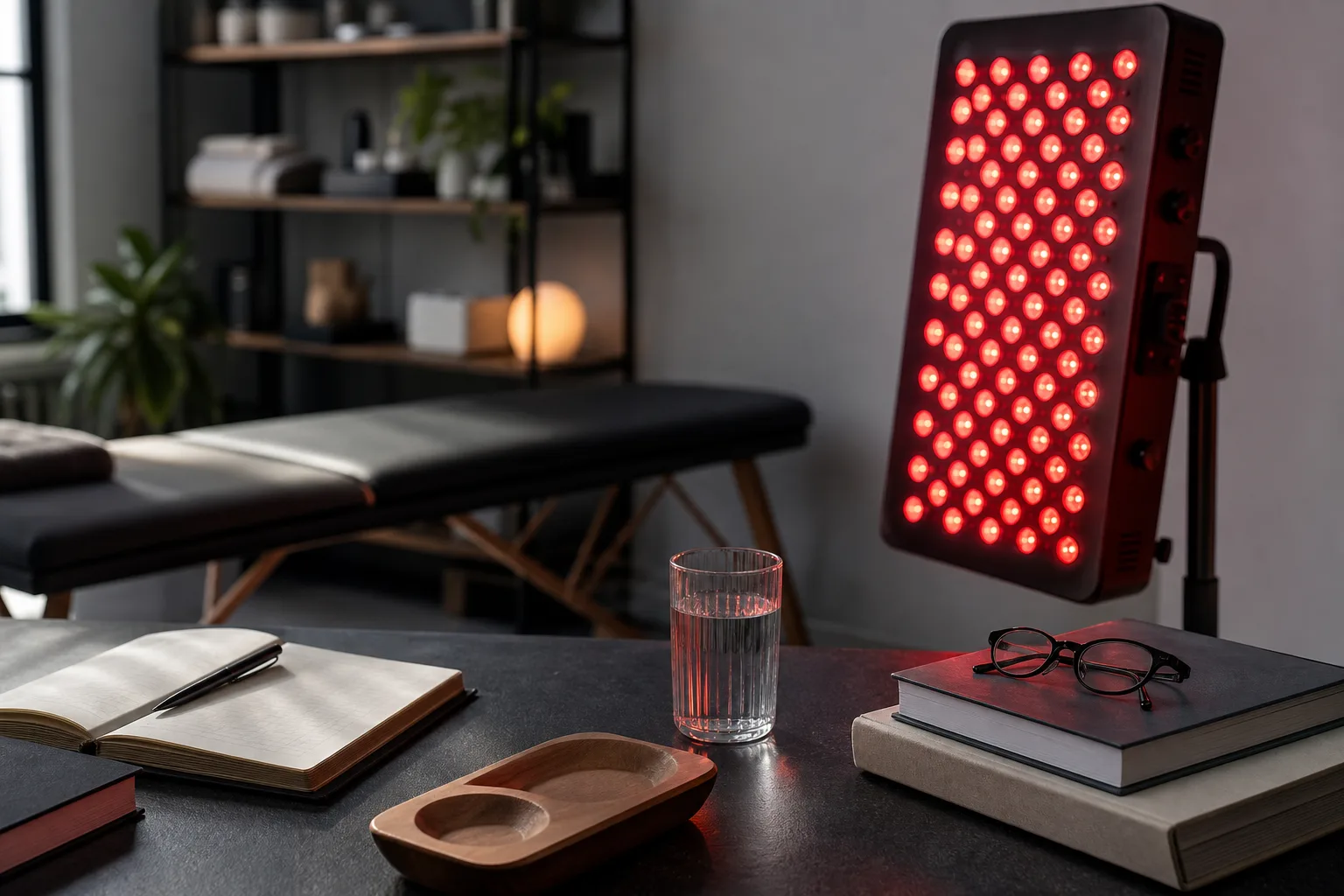
Red light therapy, also called photobiomodulation, or PBM in the research literature, beams red and near-infrared light at skin and tissue from panels, beds, or handheld devices. It's spread across recovery studios, dermatology offices, and social-media ads at roughly the same pace, which puts it in an odd spot: a modality that started in real research labs and ended up wedged between the sauna and the smoothie bar as another package add-on.
What sets it apart from most of what's on a studio menu is that it has a specific, testable proposed mechanism instead of a vague "boosts your energy" story. That's genuinely rare, and worth taking seriously. It's also exactly why it's easy to oversell. A real mechanism can be stretched to cover claims it doesn't remotely support, and a lot of red-light marketing does exactly that.
The mechanism, without the hype
The proposed target is inside your cells: mitochondria, and specifically an enzyme called cytochrome c oxidase, which is thought to absorb red and near-infrared wavelengths. The idea is that absorbing this light nudges the enzyme's activity and may modestly increase the cell's energy output for a period after exposure. That's mechanistically plausible, and it's been studied at the cell and tissue level for decades. This isn't a mechanism someone invented for a wellness pitch.
But "may increase cellular energy production" is a long way from "will speed your recovery" or "will regrow your hair." A plausible cellular mechanism tells you an effect is possible, not that it's large, not that it holds up in a full-body session, and not that it beats what your body already does on its own. Whether that nudge translates into anything you'd actually notice depends entirely on which claim you're asking about, which is why ranking the claims separately matters more than accepting or rejecting "red light therapy" as one thing.
The claims, ranked by evidence
Lump every red-light claim into one bucket and you'll either dismiss something real or buy into something imaginary. Here's the honest breakdown, tier by tier.
The best-evidenced use is local, targeted photobiomodulation for delayed-onset muscle soreness, the kind you get from a hard lift or a long run. A 2025 systematic review of photomodulation for DOMS, covering 14 controlled studies, found strength recovering measurably faster in the first day or two after training, and soreness meaningfully lower in the days that follow. That's a real, moderate-strength signal, not proof that "red light works" in general, but evidence that a panel aimed at the muscle you trained can measurably help you feel and perform better afterward.
Skin is the other area with a real evidence base, though a thinner one than most marketing implies. Consumer-health reviews list skin quality and certain wound or scar applications among the plausible benefits, while being explicit that there isn't enough evidence to support most other uses people buy red light for. Treat skin as promising and worth trying, not as a settled result.
The middle tier is where "does red light work" splits into "which red light, applied how." The DOMS evidence above comes from localized application, a panel aimed at one muscle group. Whole-body panels and beds are a different story: a 2025 review of whole-body photobiomodulation for exercise performance and recovery found no evidence of benefit across the available studies, though it flagged a possible improvement in sleep quality. If a studio is selling you a full-body bed session for muscle recovery, the evidence for that exact format is currently weaker than the evidence for a targeted panel. Joint pain sits in this same mixed tier, plausible and occasionally cited, but without the weight of evidence behind skin or localized soreness work.
Fat loss, "cellular detox," systemic anti-aging, and mood sit at the thin end. The clearer consumer-health sources on red light are direct about the first and last of those: no evidence for weight loss, and none for the mental-health claims that get bundled into a session's sales pitch. "Detox" and systemic anti-aging aren't even well-formed enough claims to have been tested, they're marketing extrapolations from the mechanism, not studied outcomes. Hair loss is common in the marketing too, but it sits outside what the available evidence can currently back with confidence, a plausible mechanism, thin data, and worth treating as an open question rather than a proven use.
| Claim | Evidence | What the research shows |
|---|---|---|
| Targeted muscle soreness (DOMS) | Moderate | 14-study 2025 review: strength recovers measurably faster and soreness runs lower — with a panel aimed at the trained muscle. [1] |
| Skin quality, wounds & scars | Promising | A real evidence base, thinner than the marketing implies — worth trying, not settled. [3] |
| Joint pain | Mixed | Plausible and occasionally cited, without the weight behind the skin or soreness work.No direct citation linked to this row. |
| Whole-body beds for recovery | Weak | A 2025 whole-body review found no performance or recovery benefit; possible sleep-quality signal. [2] |
| Hair growth | Thin | Plausible mechanism, thin data — an open question, not a proven use.No direct citation linked to this row. |
| Fat loss, “detox,” mood | None | No evidence for weight loss or the mental-health claims; “detox” isn't even a well-formed enough claim to have been tested. [3] |
Where the marketing outruns the science
The pattern across nearly every red-light pitch that goes wrong is the same move: take a real, narrow finding and let it float free of its context. A study on localized muscle soreness becomes "red light therapy speeds recovery" on a sandwich board. A plausible cellular mechanism becomes "detoxifies your cells" on a service menu, even though nothing about cellular energy production removes anything from your body. A skin-quality result becomes a hair-growth guarantee. None of these leaps are supported by the tiers above. They're the gap between what a study measured and what a business needs you to believe to sell a package.
The whole-body-bed problem is worth calling out specifically, because it's the format most studios actually sell. The strongest recovery evidence exists for localized, targeted panels, not the reclined, full-body bed experience that's easier to market and schedule. If a studio's pitch doesn't distinguish between the two, that's a signal the pitch is running ahead of what's actually been studied.
Wavelengths, dose, and why the studio panel isn't the study device
"Red light therapy" actually describes two related but distinct bands. Visible red light sits at the edge of what your eye can perceive and penetrates skin to a shallower depth; near-infrared sits just past what you can see and reaches deeper into tissue. Devices marketed simply as "red light" panels often combine both bands, and which one dominates changes what depth of tissue the light is actually reaching, a detail that rarely makes it onto a studio's price list.
Dose is the real problem underneath all of this. Wavelength, irradiance (how much light energy actually reaches your skin), distance from the panel, and exposure time all vary enormously between devices and between studios, and study protocols are specific about all four. A result generated with one calibrated panel, at a fixed distance, for a fixed number of minutes, doesn't automatically transfer to a different panel, at a different distance, for however long a studio schedules your session. This is the single biggest reason to hold any red-light claim loosely: the dose that produced a published result is rarely the exact dose you're getting.
High-intensity panels are bright enough that staring directly into them for an extended session isn't comfortable, and studios running stronger devices typically provide eye protection. Treat that as a normal, sensible precaution rather than a red flag, and ask for it if you don't see it offered.
The honest verdict
Red light therapy earns a "worth trying" verdict for a narrower group of people than the marketing suggests. If your goal is skin quality, or you're chasing an edge on post-workout soreness and you're willing to use a targeted panel rather than a whole-body bed, the evidence gives you something real to work with, modest, but real. Using it consistently and treating it as a low-risk experiment rather than something certain to work is the right frame.
It's a weak bet if you're expecting weight loss, hair regrowth, or a general "detox". The current evidence doesn't back any of those, no matter how confidently a menu states it. And it's a mediocre bet even for muscle recovery if what's on offer is a whole-body bed rather than a panel aimed at the muscle you actually trained. Ask what format you're being sold before you buy the package, not after.
Frequently asked questions
Does red light therapy actually work, or is it a placebo?
It depends on which claim you mean. For localized muscle soreness and for skin quality, there's real, if modest, published evidence beyond placebo. For whole-body recovery panels, weight loss, hair growth, and "detox," the evidence is thin to nonexistent, and much of what's sold under those claims outruns what's actually been studied.
How many red light therapy sessions does it take to see results?
There's no single settled number. The studies showing a benefit for muscle soreness measured results across repeated sessions over several days, not a single one-off session, so treat it as a cumulative practice rather than a quick fix, and don't expect a fixed timeline either way.
What's the difference between red light and near-infrared light?
Both show up in these devices, but they behave differently in tissue. Visible red light sits at wavelengths you can just perceive and penetrates skin more shallowly; near-infrared sits just beyond visible light and reaches deeper into tissue. Many panels combine both bands, which is part of why comparing devices by "wavelength" alone is misleading.
Can red light therapy damage your eyes or skin?
For most people at typical exposure, it's considered low-risk. High-intensity panels are bright enough to be uncomfortable to look at directly, and studios running stronger devices should offer eye protection, ask for it if it isn't provided. If you're on a photosensitizing medication or have an eye condition, check with a clinician before regular use.
Is red light therapy worth it for hair loss?
The mechanism is plausible, but hair loss isn't one of the better-evidenced uses on this list, it sits closer to the thin end than the skin or muscle-soreness claims. If you try it for hair, treat it as a low-cost experiment with real uncertainty, not an established use.
References
- Effects of Photomodulation Therapy for Delayed Onset Muscle Soreness: A Systematic Review and Meta-Analysis (2025, JFMK)
- A systematic review on whole-body photobiomodulation for exercise performance and recovery (2025, Lasers in Medical Science)
- Cleveland Clinic — Red Light Therapy: Benefits, Side Effects & Uses
Keep exploring
Related modalities
Related goals
Related guides
Put this guide into practice
Explore local studios or build a goal-based recovery routine.