Loading…
Recovery guide
PEMF therapy explained — what pulsed magnetic fields can and can't do
PEMF has one genuinely well-established medical use, helping stubborn bone fractures heal, and a long tail of wellness claims with far weaker support. Here's what the pulsed fields actually are, where the evidence is real, and how to think about the mat you'll lie on at a studio.
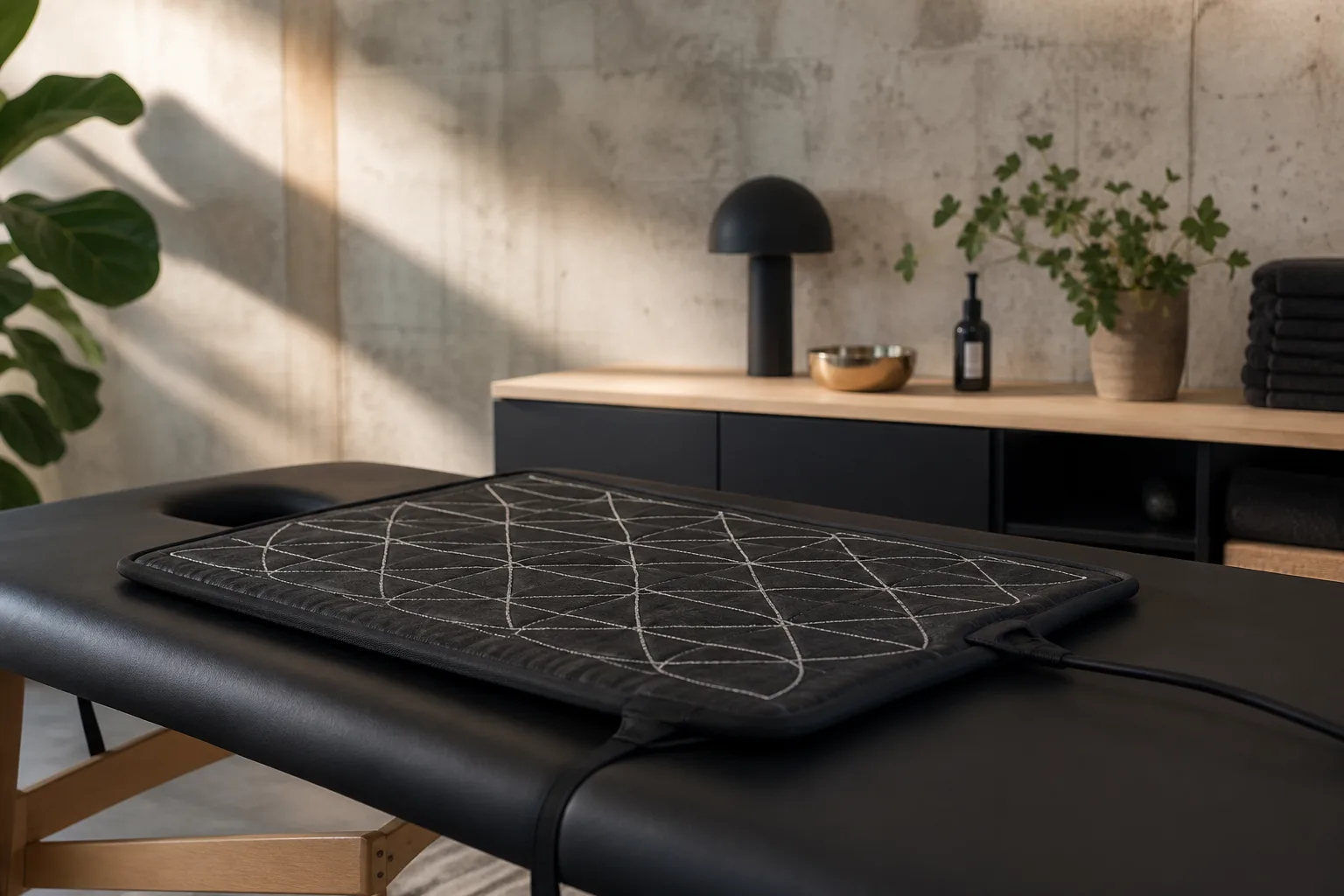
A PEMF device pulses a low-level electromagnetic field through your body. That's the entire premise. A mat, wand, ring, or pad houses a coil; run current through it and the coil generates a time-varying magnetic field that induces tiny electrical currents in nearby tissue. Most people feel nothing dramatic during a session, maybe a faint warmth or tingling, more often nothing at all, which is part of why it's easy to be skeptical of the whole category.
It's worth separating PEMF from two things people lump it in with. It isn't red light therapy: that's photons hitting cells, an entirely different mechanism with its own evidence picture (our red light therapy guide covers that one on its own terms). And it isn't a static magnet bracelet or shoe insole, either; those hold a fixed, unchanging field, and there's essentially no evidence behind them. PEMF's whole premise is the pulsing: a field that switches on and off, or varies in strength, anywhere from a few times a second to thousands of times a second. That variability is also where most of the confusion about "does PEMF work" comes from, because it isn't one intervention; it's a family of devices running wildly different settings under one marketing label.
The one thing PEMF definitively does
Bone-growth stimulation is where PEMF has the most solid ground under it. Pulsed-field devices have a long track record in orthopedics as a tool for fractures that aren't healing on their own, so-called nonunion fractures, and that use has real clinical and regulatory history behind it, not just marketing copy. It's a narrow, medical application: a specific device, a specific protocol, prescribed for a specific kind of slow-healing bone, not a general wellness intervention.
That's also exactly why it doesn't transfer cleanly to a session at a recovery studio. The devices, field strengths, and exposure schedules used for bone stimulation look nothing like the general-purpose mats and pads sold for "recovery" or "energy." A track record in one narrow medical use doesn't validate the dozen other claims layered onto PEMF marketing. That's a leap the evidence doesn't support, and it's worth saying plainly before going any further.
The evidence map for everything else
Move past bone healing and the picture gets thinner fast, though it isn't flat: some applications have more going for them than others.
Pain, especially joint pain, is the strongest of the rest. A systematic review of PEMF for osteoarthritis, mostly studied at the knee, found meaningful reductions in pain and stiffness scores across more than a thousand patients, and a smaller body of research on low back pain found PEMF used on its own eased pain and improved function, though adding it on top of standard physical therapy didn't move the needle further. Both evidence bases come from people with diagnosed joint or spine conditions, not healthy athletes chasing faster training recovery: worth remembering before you port those results onto a different context.
Everything past pain gets noticeably thinner. Claims about faster exercise recovery, better sleep, or "cellular energy" rest on a small number of studies with inconsistent protocols, and the most direct look at PEMF as a training-recovery add-on describes the evidence as early and calls for substantially more research before drawing conclusions. This is honestly the thinnest-evidence topic in this guide series: whole-body wellness claims for PEMF, energy, immunity, general vitality, are not supported by good evidence, however common they are on a studio menu. Treat these as open questions rather than an established effect that comes bundled with the session price.
Frequencies, gauss, and why comparing devices is nearly impossible
Here's the practical problem with all of the above: "PEMF" isn't a standardized dose the way a cold plunge temperature is. Frequency (how many times per second the field pulses), intensity (field strength, usually in gauss or millitesla), waveform shape, and session length all vary by orders of magnitude between devices. A low-intensity consumer mat and a high-intensity clinical unit can both be labeled "PEMF" while doing almost nothing alike to your tissue.
That matters because a study's result is tied to its specific device and protocol. A finding from a clinical-grade osteoarthritis device doesn't automatically apply to the wellness mat at your local studio, and there's no simple conversion between the two. If you're curious what a given studio's device is actually capable of, the honest questions to ask are concrete: what frequency and intensity does it run, what protocol are they following, and is it remotely the same category of device used in the research they're pointing to. A studio that can answer specifically is a different proposition from one that just gestures at a testimonial wall.
Should you try a PEMF session?
For pain-adjacent goals (a cranky knee, a stiff low back), PEMF is a reasonable, low-risk thing to try, especially alongside whatever else you're already doing for it rather than instead of it. For general "recovery" or "energy" goals, go in with modest expectations; the evidence just isn't there yet to promise much beyond how the session itself feels.
The safety profile is genuinely good for most people, which is part of why it's easy to oversell: a passive, no-downside-feeling session is a comfortable thing to market hard. The firm exceptions are worth stating plainly: skip PEMF if you have a pacemaker or any other implanted electronic device, since pulsed fields can interfere with how those devices function, and skip it if you're pregnant. A studio should be screening for both before you ever lie down, not after. Outside of those two situations, the honest verdict is: cheap to try, easy to stop, and worth pricing like the experiment it is rather than the miracle fix it's sometimes sold as.
Frequently asked questions
Does PEMF therapy actually work, or is it pseudoscience?
Neither, cleanly. PEMF's strongest ground is medical: pulsed-field devices have a real history stimulating bone healing in slow-mending fractures, and a body of research on joint pain, especially knee osteoarthritis, and low back pain shows a real, if modest, effect. Past pain, the evidence for general recovery or energy claims is thin and preliminary, so a blanket "it works" or "it's fake" both oversimplify a genuinely mixed picture.
What does a PEMF session feel like?
For most people, not much. You lie on a mat or near a device for roughly 15 to 30 minutes and may notice a faint warmth or tingling, or nothing at all. It's entirely passive, no exertion, no discomfort, nothing resembling the intensity of a cold plunge or sauna session.
Is PEMF the same as red light therapy?
No, they're often sold on the same studio menu, but the mechanisms are unrelated. Red light therapy uses photons absorbed by cells; PEMF uses a pulsing electromagnetic field that induces tiny electrical currents in tissue. Neither substitutes for the other, and their evidence bases don't transfer between them.
Who should not use PEMF therapy?
Anyone with a pacemaker or another implanted electronic device should skip it, since pulsed electromagnetic fields can interfere with how those devices function. Pregnant people should also avoid it. A studio should be asking about both conditions before a session, not after.
How many PEMF sessions does it take to notice anything?
There's no settled number, and it depends heavily on the goal and the device. Studies on joint pain often run multiple sessions a week over several weeks before measuring results. For general wellness goals, the evidence isn't strong enough to say how many sessions would meaningfully change anything, so treat an early "no difference" as informative rather than a reason to buy a bigger package.
References
- Pulsed electromagnetic field therapy effectiveness in low back pain: A systematic review of randomized controlled trials (Porto Biomedical Journal, 2016)
- Current Evidence Using Pulsed Electromagnetic Fields in Osteoarthritis: A Systematic Review (Journal of Clinical Medicine, 2024)
- Pulsed Electromagnetic Field (PEMF) stimulation as an adjunct to exercise: a brief review (Frontiers in Sports and Active Living, 2024)
Keep exploring
Related modalities
Related goals
Related guides
Put this guide into practice
Explore local studios or build a goal-based recovery routine.