Loading…
Recovery guide
Compression therapy — how pneumatic boots work and what they actually do
Pneumatic compression moves fluid: that's the whole mechanism, and it's genuinely useful for the right problems. Here's what the sequential squeeze does to your circulation, what the research supports, and why a stronger setting isn't a better session.
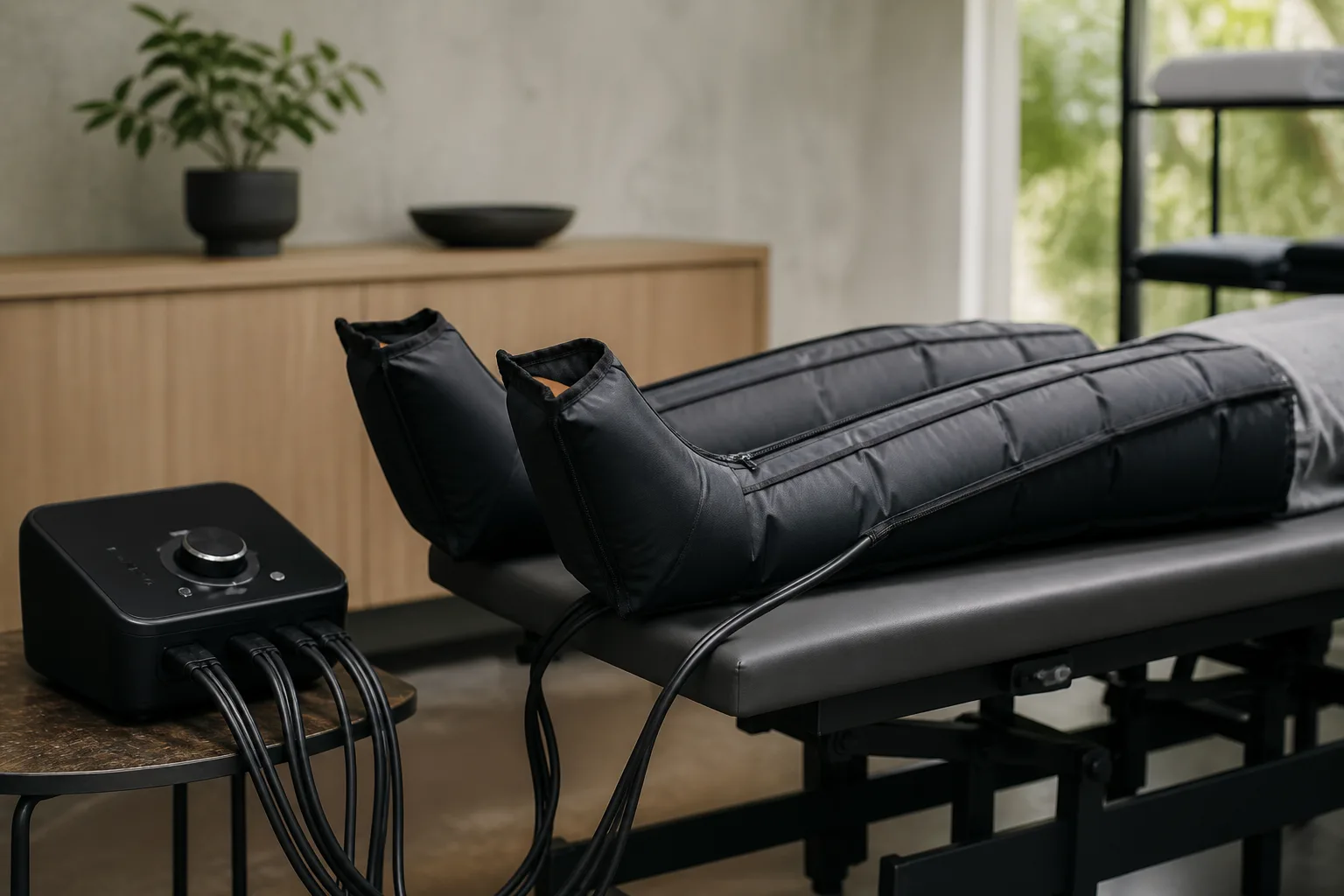
The boots go on, a hose connects to a pump, and a wave of air pressure moves up your leg from ankle to hip in a slow, deliberate squeeze. That's the entire technology. There's no heat, no vibration, nothing electrical happening inside the muscle, just air pressure applied in a pattern that mimics what your calf muscles do naturally when you walk.
People love it anyway, and not without reason. Twenty minutes in a recliner with compression boots on is one of the more pleasant twenty minutes available at a recovery studio, and pleasant matters: feeling like you did something for tired legs after a hard training block or a long flight has value before you even get to what the research shows. The honest question isn't whether it feels good. It's whether the feeling is doing anything, and the answer is a qualified yes.
The mechanism: your circulatory system, assisted
Blood returning to your heart from your legs has to fight gravity, and it mostly does that through two passive systems: one-way valves in your veins and the rhythmic squeeze of your calf and thigh muscles as you move. Sit or stand still for hours, after leg day, after a flight, after a long shift on your feet, and that return slows down. Fluid pools in your lower legs, and you feel the heaviness.
Pneumatic compression boots substitute a machine for the muscle pump. Chambers built into the sleeve inflate in sequence, starting at the foot or ankle and moving upward, squeezing each segment briefly before releasing and moving to the next. That sequential pattern, not just clamping the whole leg at once, is what pushes venous blood and lymphatic fluid back toward your core more efficiently than static compression would.
Most devices used in studios run sessions of roughly 20 to 30 minutes; the sports-recovery protocol most often studied uses a pressure around 80 mmHg, firm enough to feel like a deliberate squeeze, not a spa massage. Exact settings vary by device and studio, and pressure is a dial that should be adjusted to your comfort, not maxed out by default.
What the studies show, and what they don't
The best current evidence comes from a 2024 systematic review and meta-analysis pooling 17 randomized trials and roughly 320 participants on lower-limb pneumatic compression after exercise. It found a trivial-to-small benefit for restoring muscle function and a trivial-to-moderate benefit for perceived soreness and pain, with the pain benefit strongest around 48 hours after exercise. Objective markers of muscle damage, the blood tests researchers use to measure actual tissue injury, didn't move consistently either way. In plain terms: you're likely to feel less sore and less heavy-legged, but the fluid-moving mechanism isn't shown to speed up tissue repair itself.
There's also decent evidence for something narrower and less talked about: your cardiovascular system. A small randomized trial found that 30 minutes of pneumatic compression after repeated sprint efforts sped the return of heart rate, blood pressure, and cardiac output to baseline compared with a sham device. That's a specific finding about circulatory recovery, not a general claim about muscle repair or next-day performance, and it hasn't been replicated at scale.
Where the evidence goes quiet is performance. Nothing in the current research shows compression boots improving next-day strength or power output. If a studio implies the boots will make you perform better tomorrow, that claim is running ahead of what's been studied.
Boots vs. lymphatic massage vs. compression garments
Three things get lumped together under "compression" at a studio, and they're not the same tool. Pneumatic boots are the machine described above, sequential air chambers, a defined session, a device you sit in. Manual lymphatic drainage is a trained therapist's hands-on technique, slower and more targeted, and it's the modality most often used post-surgically to manage swelling. Compression garments, the tight sleeves and tights athletes wear for hours, sometimes overnight, are a third category entirely: static, sustained pressure instead of a rhythmic pump.
They're not interchangeable, and the evidence doesn't transfer cleanly between them either. A 2025 meta-analysis of 27 studies found compression garments produce small but statistically real improvements in strength and power recovery, more pronounced in trained athletes and in the legs, a garments-specific finding, not a boots finding, even though the underlying idea (assisting venous return) is the same. If a studio's marketing cites "compression research" without saying which category, ask which one they mean; the mechanism is shared, but the dose and the delivery aren't.
Who benefits most, and who must skip it
Runners nursing heavy legs, anyone who just finished a long-haul flight, people on their feet all day, and lifters the day after a brutal leg session tend to get the most out of a session, situations where fluid has genuinely pooled and a mechanical assist has something real to work against. If your legs feel heavy and swollen rather than just tired, compression is doing something a foam roller can't.
The one hard exception matters more than every other consideration in this guide combined: if you have a suspected or diagnosed blood clot, deep vein thrombosis (DVT), do not use pneumatic compression, and don't let a studio talk you into it. Mechanically pushing fluid up the leg risks dislodging a clot and sending it toward your lungs or heart, which is a medical emergency, not a recovery setback. The same caution applies to unexplained calf swelling, redness, or pain that hasn't been evaluated, get it checked by a clinician before, not after, a session. A studio with real safety practice will ask about this before your first session, not assume it's fine.
What a good session looks like
A good session runs 20 to 30 minutes, long enough for the sequential pattern to cycle through your legs several times but short enough that you won't get restless in a recliner. Pressure should feel like a firm, steady squeeze, noticeable, occasionally a little intense as a chamber peaks, but never sharp or painful. If a setting makes you wince or leaves marks, that's not a stronger session; it's just an uncomfortable one. More mmHg doesn't move more fluid past a certain point; it just makes the twenty minutes worse.
Timing-wise, compression pairs well at the end of a training day, after a long travel day, or on a rest day when your legs feel heavy but you don't want another stimulus. Some people stack it with cold exposure in the same visit, if you're building a cold-plunge habit alongside compression, our guide on how often to cold plunge covers the dosing details for that half of the pairing, and our compression-vs-cold-plunge comparison walks through when to pick one over the other. If you're weighing compression against a passive modality like PEMF instead, our compression-vs-PEMF comparison covers that head-to-head. Compression itself is low-fatigue enough to do several times a week without much downside, aside from the time it takes.
Frequently asked questions
Do compression boots actually help recovery, or do they just feel good?
Both, honestly. The best current evidence shows a trivial-to-small benefit for muscle function and a trivial-to-moderate reduction in soreness after hard exercise, real but modest effects, not a dramatic recovery upgrade. The comfort and the feeling of doing something for tired legs is a genuine part of the value, not a consolation prize.
How long should you sit in compression boots?
Most studio sessions run 20 to 30 minutes, which matches the protocol most often used in research on the modality. Longer isn't shown to be better: the sequential squeeze does its work within that window, and sitting longer mostly just costs you time.
What pressure should compression boots be set at?
Aim for a firm, noticeable squeeze that never crosses into pain. Studies on the modality commonly use pressure around 80 mmHg, but comfortable settings vary by device and person. Cranking the pressure higher doesn't move more fluid past a certain point; it just makes the session harder to sit through.
Can compression therapy help with swollen legs from standing or flying?
Yes, pooled fluid from long standing or sitting is exactly the kind of thing sequential pneumatic compression is built to move. If the swelling is new, one-sided, painful, or otherwise unexplained rather than the familiar heaviness from a long day, get it checked by a clinician before assuming compression boots are the fix.
Who should not use compression boots?
Anyone with a suspected or diagnosed blood clot (DVT) should not use pneumatic compression: it risks dislodging the clot, which is a medical emergency. Unexplained leg swelling, redness, or pain that hasn't been evaluated by a clinician is also a reason to hold off and get checked first, rather than push through a session.
References
- Effects of lower-limb intermittent pneumatic compression on sports recovery: A systematic review and meta-analysis (Biology of Sport, 2024)
- Effects of intermittent pneumatic compression on the recovery of cardiovascular parameters after repeated sprint exercise (European Journal of Applied Physiology, 2023)
- Effects of Compression Garments on Muscle Strength and Power Recovery Post-Exercise: A Systematic Review and Meta-Analysis (Life, 2025)
Keep exploring
Related modalities
Related goals
Related guides
Put this guide into practice
Explore local studios or build a goal-based recovery routine.