Loading…
Modality comparison
Cryotherapy vs infrared sauna: heat and cold at opposite extremes
Whole-body cryotherapy at -200°F and infrared sauna at 120–150°F represent the two poles of thermal recovery. They work through opposing mechanisms, serve different goals, and often belong in the same protocol rather than an either/or decision.
Quick verdict
Choose cryotherapy if…
Cryotherapy is popular with competitive athletes, active individuals managing post-workout inflammation or chronic joint pain, and people seeking fast-acting wellness interventions.
Cryotherapy guide →Choose infrared sauna if…
Infrared sauna appeals broadly to athletes, office workers with chronic stress or tension, and individuals managing mild chronic pain or stiffness.
Infrared sauna guide →| Aspect | Cryotherapy | Infrared sauna |
|---|---|---|
| Temperature | -200 to -250°F (dry nitrogen vapor) | 120–150°F (radiant far infrared heat) |
| Session length | 2–4 min | 20–45 min |
| Primary effect | Vasoconstriction, anti-inflammatory, norepinephrine spike | Vasodilation, heat-shock response, deep relaxation |
| Best for | Acute inflammation, energizing reset, time-efficient cold exposure | Detox, chronic pain, sleep, cardiovascular load, relaxation |
| After-feel | Alert, energized, sharp | Calm, loose, deeply relaxed |
| Typical cost | $50–$100 / session | $30–$70 / session |
The breakdown
What cryotherapy does
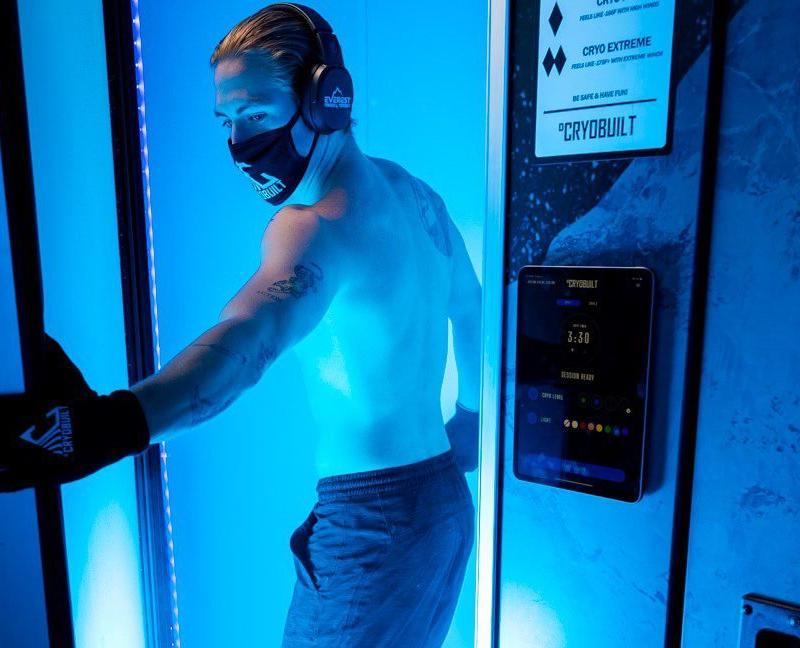
In a whole-body cryotherapy chamber, nitrogen vapor drops the surrounding air temperature to -200°F or below for 2–4 minutes. Your skin surface temperature falls rapidly, triggering vasoconstriction throughout the body and a sharp hormonal response, primarily norepinephrine and adrenaline. The result is an energized, alert feeling that most users describe as euphoric.
Cryotherapy's appeal for recovery is the speed: the session itself takes minutes, there's no wetness, and the anti-inflammatory response kicks in quickly. It's a popular post-game or post-training tool among athletes with tight schedules.
What infrared sauna does
An infrared sauna uses far infrared radiant heat to warm your body directly (not the ambient air), running at 120–150°F rather than the 180–200°F of traditional saunas. Core temperature rises over 20–45 minutes, triggering vasodilation, cardiovascular strain comparable to light exercise, and heat-shock protein production.
The relaxation response is significant and sustained. Most people emerge from an infrared session calm, loose, and ready for rest: the opposite of the post-cryo feeling. This makes infrared sauna a natural fit for evening recovery, sleep preparation, and chronic pain management.
How to decide: goals and timing
Cryotherapy wins when: you need fast, time-efficient cold exposure; you're dealing with acute inflammation or soreness; or you want an energy boost before an afternoon workout or event. It fits into a busy schedule in a way that a 45-minute sauna session doesn't.
Infrared sauna wins when: the goal is deep relaxation, sleep improvement, detox, cardiovascular health maintenance, or chronic pain relief. It's also the better choice when you have more time and want the full 'recovery ritual' experience.
Many studios that offer cryotherapy also offer infrared sauna, and using both in the same day (cryo in the morning, sauna in the evening, or vice versa) is a legitimate protocol, not overkill.
Try both, decide yourself
Run the experiment yourself
Studios running both cryotherapy and infrared sauna — verified partners lead. Book a session of each and let your own recovery decide.
DOC's
Wall, NJ
5.0· 1 Google review
DOC's is a Wall, NJ recovery facility offering innovative holistic therapies for athletic performance and life extension — whole-body cryotherapy, hyperbaric oxygen, Normatec compression, Sunlighten infrared sauna, and Theralight red light.
CryotherapyHyperbaric oxygenCompression therapyInfrared sauna+1
01
Next Health
West Hollywood, CA
5.0· 2291 Google reviews
Next Health is a health and wellness center at The Sunset on Sunset Boulevard in West Hollywood.
IV & hydrationIV Hydration / Vitamin (Myers-type) TherapyCryotherapyHyperbaric oxygen+3

02
Next Health West Hollywood
Sunset Strip · West Hollywood, CA
5.0· 2250 Google reviews
West Hollywood wellness center for NAD+, IV drips, hormone therapy, infrared therapy, hyperbaric oxygen, EBOO ozone & plasma exchange on the Sunset Strip.
CryotherapyHyperbaric oxygenInfrared saunaRed light therapy+1
03
Next Health
New York, NY
5.0· 1217 Google reviews
Next Health offers IV therapy, cryotherapy, and hyperbaric oxygen treatments at their wellness center on Madison Avenue, specializing in advanced regenerative medicine and longevity optimization.
CryotherapyIV & hydrationHyperbaric oxygenInfrared sauna+1

04
Restore Hyper Wellness
Houston, TX
5.0· 1168 Google reviews
Restore Hyper Wellness is a wellness studio in West University, Houston, at 2715 Bissonnet St., Suite 140.
CryotherapyRed light therapyInfrared saunaCompression therapy+4
Questions
Frequently asked questions
Is cryotherapy or infrared sauna better for muscle recovery?
They help at different stages. Cryotherapy is better for acute recovery: directly after intense training, when you want to reduce inflammation and soreness fast. Infrared sauna is better for longer-term recovery, circulation, and relaxation on rest days. Many athletes use both depending on where they are in their training cycle.
Which should I do first, cryo or sauna?
There's no fixed rule. If you do both in the same day, some people prefer sauna first to warm up and then cryo to finish energized. Others do cryo first to reduce inflammation and then sauna to relax. The sequencing matters less than consistency over time.
How often should I do cryotherapy vs infrared sauna?
Cryotherapy 2–4 times per week is a common protocol for athletic recovery. Infrared sauna 3–5 times per week is within the range most wellness practitioners suggest for general health benefits. Both are generally considered safe for regular use, though individual tolerance varies. Start with 1–2 sessions per week for each and assess your response.
References
- Impact of different cryotherapy interventions on post-exercise acute delayed-onset muscle soreness, athletic performance, and inflammatory biomarkers: a systematic review and network meta-analysis
- Whole-body cryotherapy can reduce the inflammatory response in humans: a meta-analysis based on 11 randomized controlled trials
- Is whole-body cryostimulation an effective add-on treatment in individuals with fibromyalgia and obesity? A randomized controlled clinical trial
- Efficacy of whole-body cryotherapy as add-on therapy to pharmacological treatment of depression: a randomized controlled trial
- Efficacy of Waon therapy for fibromyalgia
- The effects of repeated thermal therapy for patients with chronic pain
- Waon Therapy for Managing Chronic Heart Failure: results from the multicenter prospective randomized WAON-CHF study
- Non-acute effects of passive heating interventions on cardiometabolic risk and vascular health: systematic review and meta-analysis of randomized controlled trials
- Clinical Effects of Regular Dry Sauna Bathing: A Systematic Review
- Far-infrared saunas for treatment of cardiovascular risk factors: summary of published evidence
Keep exploring
The full guides
More head-to-heads
Compression therapy vs cold plunge →Float therapy vs red light therapy →Infrared sauna vs halotherapy →IV hydration vs hyperbaric oxygen →Contrast therapy vs cryotherapy →PEMF vs compression therapy →Lymphatic compression vs compression therapy →Red light therapy vs cryotherapy →Infrared sauna vs cold plunge →Cryotherapy vs cold plunge →PEMF vs red light therapy →Hyperbaric oxygen vs red light therapy →