Loading…
Team sports
Ice Hockey — Recovery Through the Training Year
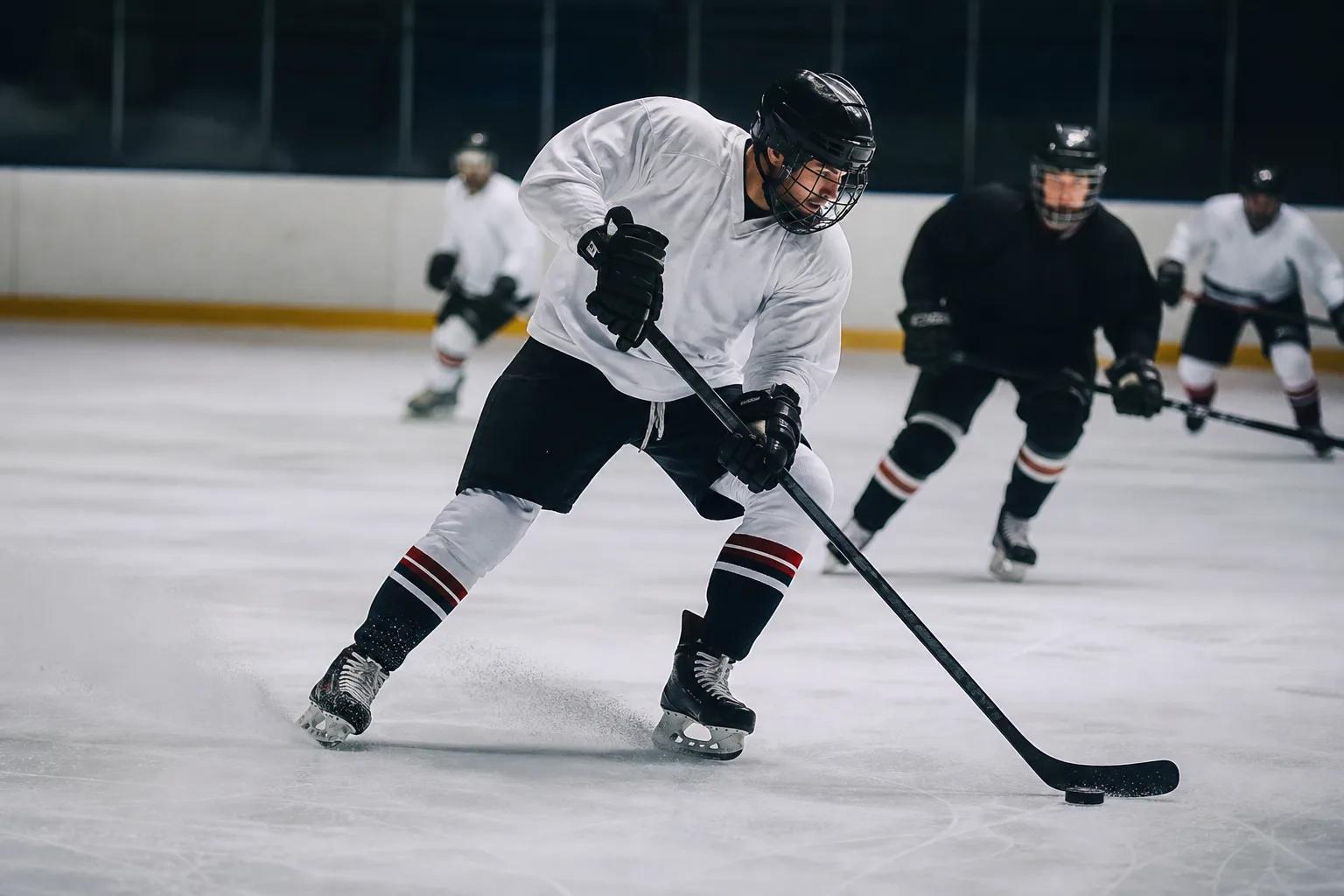
Ice hockey stacks repeated high-intensity skating shifts, rapid direction changes and contact, with groin, knee, shoulder and whole-body fatigue shaped by position.
The training year
Recovery changes with the season
In season, the job is turnaround between skating and contact exposures; in the short spring gap, the focus shifts to restoring hip capacity, strength and movement before ice volume rises again.
Jun–Sep
Pre-season
Dry-land conditioning and progressive return to skating, followed by camp and exhibition games as ice time rises.
Protocols for this phase →Oct–Mar
In-season
League and tournament season. Games, practices and travel create the highest repeated skating and contact load.
Protocols for this phase →Apr–May
Off-season
The main gap after winter league and tournament play. Contact volume drops and strength, hip capacity and skating mechanics can be rebuilt.
Protocols for this phase →Wellness and training information, not medical advice. Recovery modalities are a support to good programming, sleep and nutrition — they do not treat, cure, or diagnose injury, and no session guarantees a performance outcome. Pain that persists or worsens deserves evaluation by a clinician or athletic trainer before you train through it.
The demands
What ice hockey asks of the body
Ice hockey is built from short, intense shifts separated by longer bench recovery. Players repeatedly accelerate, brake, turn and battle while skating in a flexed posture, so the hips and groin work continuously even before contact is counted. Games add board, player and puck contact, while a congested week can repeat that load before strength and skating power have fully returned. Forwards, defense players and goaltenders do different work, making position as important as minutes played.
Also known as hockey, ice-hockey, rink hockey, adult league hockey
The load profile
- repeated skating sprints
- rapid acceleration and braking
- hip and groin endurance
- collision and board contact
- sustained flexed skating posture
From demands to modalities
What studios pair with this load
The demands above are the input. These are the modalities recovery studios commonly pair with that kind of load — read what each actually does before you book.
The load
- repeated skating sprints
- rapid acceleration and braking
- hip and groin endurance
- collision and board contact
- sustained flexed skating posture
What studios pair with it
Assisted stretch
Practitioner-assisted stretch
Pairs with: hip and groin endurance · sustained flexed skating posture
What it does →Compression therapy
Air-pressure compression
Pairs with: hip and groin endurance · collision and board contact
What it does →Cold plunge
Cold-water immersion
Pairs with: collision and board contact
What it does →Contrast therapy
Alternating hot & cold
Pairs with: collision and board contact
What it does →A reading map, not a prescription — each page explains what a session involves and what the evidence shows. For condition-level evidence, start at the conditions library.
By position
The same sport, different jobs
Load isn't evenly distributed across a roster — what wears down depends on where you play.
Forwards
More high-intensity skating and repeated forecheck or backcheck efforts, with frequent accelerations and short bench recovery.
repeated skating sprintsrapid accelerationpuck battles
Defense
Backward skating, pivots, board battles and often longer on-ice sequences shift load toward the hips, groin and contact tolerance.
backward skatingpivot and braking loadboard contact
Goaltenders
A distinct profile of repeated lateral pushes, drops and recoveries from deep hip and knee positions; skating distance is a poor proxy for load.
lateral powerdeep hip and knee positionsrepeated drop and recovery
Gear and surface
What changes how the load lands
Two athletes on the same schedule can accumulate very differently depending on what they train on and in.
Skate fit and blade setup affect foot, ankle and hip mechanics; protective equipment adds carried mass and changes heat load. Equipment reduces some trauma but does not remove collision or fall exposure.
What tends to show up
Common complaints, and where to read more
Plain-language descriptions of what athletes in this sport report. Where a cited evidence guide exists, the entry links to it.
Muscle Strain / Pulled Muscle
A muscle strain is a stretch or tear of muscle fibers, commonly from sudden force, twisting, overuse, under-recovery, or insufficient warm-up.
Browse all conditions →Delayed Onset Muscle Soreness
Delayed onset muscle soreness is the one recovery target where the research is genuinely deep, and several modalities do reduce how sore you feel.
See the evidence →Hip Pain
Hip pain is discomfort in or around the hip joint, outer hip, groin, or nearby muscles, often related to arthritis, bursitis, overuse, strain, or injury.
Browse all conditions →Knee Pain
Knee pain is discomfort in or around the knee joint from overuse, arthritis, injury, movement load, or irritation of muscles, tendons, ligaments, or cartilage.
Browse all conditions →For parents and coaches
For youth players, tournament weekends and overlapping teams can hide the true number of games. Checking rules matter, but schedule density and total ice time matter too.
Near you
Find recovery near you
The directory behind Praxium — studios by city and modality. Start where coverage runs deepest, or browse everything.
Questions
Frequently asked questions
Why are the groin and hips sore after skating?
Every stride uses hip extension and abduction from a flexed position, and repeated starts, stops and turns compound that load. Sharp pain, loss of push-off or pain that worsens each skate needs assessment rather than routine soreness care.
Do forwards and defense players need the same turnaround?
Not exactly. Forwards usually accumulate more high-intensity skating, while defense players may carry different backward-skating, contact and on-ice-time demands. Minutes, shift pattern and role should shape the plan.
What about goaltenders?
Goaltending is a separate demand profile built around repeated drops, lateral pushes and deep hip positions rather than continuous skating distance. A goalie should not inherit a skater's plan by default.
I took a hard hit and feel foggy. Is recovery work appropriate?
No. Symptoms after head contact require medical assessment. Nothing on this page should be used to speed return after a suspected concussion.
Does non-checking adult hockey count as full-contact load?
The rules reduce deliberate checking, but falls, board contact, puck contact and incidental collisions still occur. The honest input is the player's actual game, not the league label alone.
Keep exploring
Conditions referenced
Recovery goals
Guides
The beginner's guide to recovery modalities: what each one does and where to start →How often should you cold plunge? Dose, duration, and when more backfires →Contrast therapy: how to alternate hot and cold, and why the order matters →Red light therapy: what the evidence supports, and what it doesn't →Compression therapy: how pneumatic boots work and what they actually do →PEMF therapy explained: what pulsed magnetic fields can and can't do →Is whole-body cryotherapy worth it? A cost-benefit look →
Turn a season into a plan
Take the 2-minute Modality Match quiz and get a starting point built around how you train — which modalities to look at first, and which to run past a clinician.
Wellness and training information, not medical advice. Recovery modalities do not treat, cure, or diagnose any injury or condition and never replace care from a qualified clinician, athletic trainer, or physical therapist.