Loading…
Team sports
Football — Recovery Through the Training Year
Football rosters span athletes who collide on every snap and others who sprint at maximum for four seconds, and recovery splits too.
The training year
Recovery changes with the season
In-season, recovery buys back the 48 hours between Friday night and Monday practice; off-season, it buys the training volume that makes next August survivable.
Jun–Jul
Pre-season
Summer conditioning, 7-on-7 and team camp. Volume climbs without the contact.
Protocols for this phase →Aug–Dec
In-season
August camp through November/December playoffs. Fixed Friday-game weekly rhythm.
Protocols for this phase →Jan–May
Off-season
Winter/spring lifting and speed block. No games, so nothing on the calendar forces the week's shape.
Protocols for this phase →Wellness and training information, not medical advice. Recovery modalities are a support to good programming, sleep and nutrition — they do not treat, cure, or diagnose injury, and no session guarantees a performance outcome. Pain that persists or worsens deserves evaluation by a clinician or athletic trainer before you train through it.
The demands
What football asks of the body
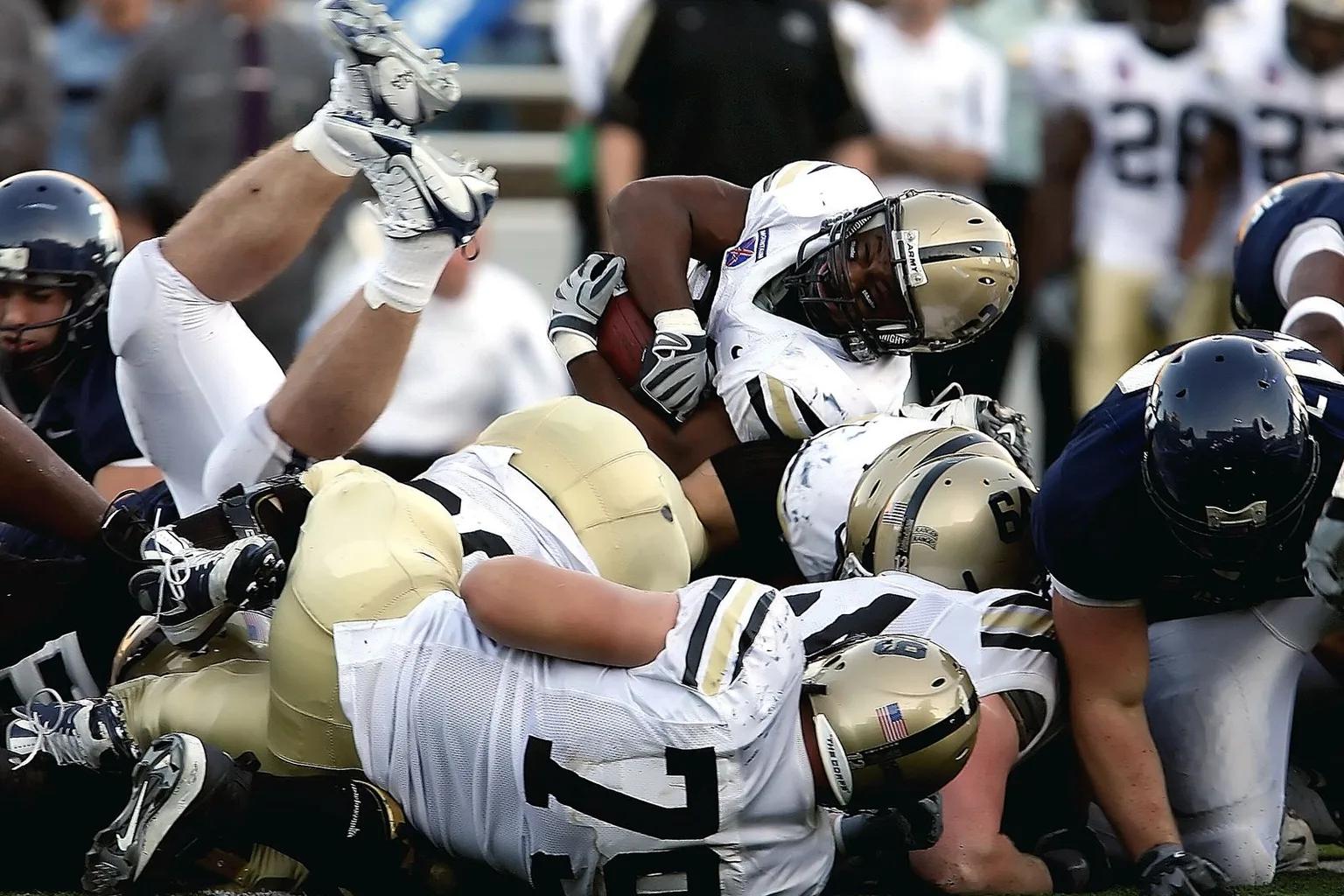
A football year is really two years stacked. From August to December the athlete plays inside a fixed weekly rhythm — a Friday game, a heavy Saturday, and a Monday practice that arrives before the soreness has cleared — and the job of recovery is turnaround. From January to July there is no game to recover from, and the job flips entirely: recovery is what lets an athlete lift more, sprint more often, and add capacity without accumulating the joint and tissue soreness that ends spring blocks early. The two jobs need different cadences, different session lengths, and a different conversation with the family.
Also known as American football, tackle football, HS football, gridiron
The load profile
- collision load
- repeat sprint
- max-effort short bursts
- heavy axial resistance training
- positional asymmetry
From demands to modalities
What studios pair with this load
The demands above are the input. These are the modalities recovery studios commonly pair with that kind of load — read what each actually does before you book.
The load
- collision load
- repeat sprint
- max-effort short bursts
- heavy axial resistance training
- positional asymmetry
What studios pair with it
Cold plunge
Cold-water immersion
Pairs with: collision load · repeat sprint · max-effort short bursts
What it does →Contrast therapy
Alternating hot & cold
Pairs with: collision load · repeat sprint · max-effort short bursts
What it does →Compression therapy
Air-pressure compression
Pairs with: collision load · repeat sprint · max-effort short bursts
What it does →Percussion therapy
Percussive / vibration
Pairs with: heavy axial resistance training
What it does →A reading map, not a prescription — each page explains what a session involves and what the evidence shows. For condition-level evidence, start at the conditions library.
By position
The same sport, different jobs
Load isn't evenly distributed across a roster — what wears down depends on where you play.
Linemen (OL/DL)
Highest collision volume and the heaviest axial load in the sport. Low-back and knee soreness dominate; the largest athletes also carry the most heat load in August.
collision loadheavy axial resistance trainingsustained isometric bracing
Skill (WR/DB/RB)
Repeat maximal sprint. Posterior-chain tightness and calf/hamstring load dominate; contact is high-speed but lower-frequency.
repeat sprintmax-effort short burstsdeceleration
Linebackers
Hybrid — collision volume close to the line plus sprint volume close to the skill group. Usually the highest total-load athlete on the roster.
collision loadrepeat sprintchange of direction
Quarterbacks & specialists
Lowest collision volume, highest overhead-rotation and single-leg-plant volume. Throwing-shoulder and lead-hip load, not contact load.
overhead rotationsingle-leg plantrotational power
Gear and surface
What changes how the load lands
Two athletes on the same schedule can accumulate very differently depending on what they train on and in.
Helmet and shoulder pads add 12–18 lb of carried mass and shift load to the neck and upper back — a demand that only exists from August onward and disappears entirely in the spring block. Cleat stiffness drives forefoot load on turf.
What tends to show up
Common complaints, and where to read more
Plain-language descriptions of what athletes in this sport report. Where a cited evidence guide exists, the entry links to it.
Delayed Onset Muscle Soreness
Delayed onset muscle soreness is the one recovery target where the research is genuinely deep, and several modalities do reduce how sore you feel.
See the evidence →Reduced Range of Motion / Muscle Tightness
Temporary loss of joint range/muscle pliability with training, DOMS, or inactivity.
Browse all conditions →Knee Pain
Knee pain is discomfort in or around the knee joint from overuse, arthritis, injury, movement load, or irritation of muscles, tendons, ligaments, or cartilage.
Browse all conditions →Edema / Swelling
Localized fluid accumulation / swelling (post-exercise, post-eccentric, occupational, post-injection). Compression therapy and localized cryotherapy reduce acute swelling (Grade…
Browse all conditions →Exercise / training recovery
Exercise and training recovery describes the need to rebound between workouts, practices, races, or physically demanding shifts with less soreness and better readiness.
Browse all conditions →Hamstring Injury / Pulled Hamstring
A hamstring injury is a strain or tear in the muscles at the back of the thigh, common with sprinting, jumping, lunging, or sudden forceful movement.
Browse all conditions →Delayed-onset soreness after contact days
Muscle soreness that peaks 24 to 72 hours after a collision day, which puts the worst of it squarely in the Friday-to-Monday window.
See the evidence →Deep bruising and contusions
Deep, tender bruising in the thighs and upper arms from contact. It colours late and stays sore after it stops looking dramatic.
See the evidence →Turf toe and forefoot load
Soreness at the base of the big toe and across the forefoot from pushing off on artificial turf. Typically worse in cutting and acceleration.
Browse all conditions →For parents and coaches
The four months your athlete is not playing are the four months their body actually rebuilds. Off-season visits are about walking into August camp able to handle the load, not about fixing something that went wrong.
Near you
Find recovery near you
The directory behind Praxium — studios by city and modality. Start where coverage runs deepest, or browse everything.
Questions
Frequently asked questions
Why does my athlete feel worse two days after a game than the day after?
That pattern is normal. Delayed-onset muscle soreness usually starts 6–12 hours after hard or collision-heavy work, peaks somewhere between 24 and 72 hours, and eases over about five to seven days. For a Friday game that puts the low point on Sunday or Monday, which is why Monday practice so often feels worse than Saturday.
Is off-season recovery worth paying for when there are no games?
The off-season is when training volume is highest and the athlete is adding capacity, so soreness management is doing a different job — it supports the lifting and speed work rather than a game turnaround. Whether that is worth paying for is your call; nobody can promise it changes a season's outcome.
August camp is brutal in the heat. What actually matters there?
Gradual heat acclimatization matters most. Reviews of high-school football preseason data associate mandated acclimatization periods with lower rates of exertional heat illness. Cooling after practice is comfort and recovery; it is not a substitute for a properly ramped first two weeks, and it does not make an unacclimatized athlete safe.
He got hit in the head and seems off. Should he do a recovery session?
No. A suspected head impact is a medical evaluation, not a recovery session. Nothing on this page applies until a qualified clinician has cleared him, and no recovery modality should be used to get an athlete back on the field sooner after a head injury.
Does playing only football year-round help him get ahead?
The research on youth sport specialization points the other way — athletes who specialize earlier and train one sport intensely year-round tend to report more overuse injuries, without clear evidence of better outcomes. Playing more than one sport is generally treated as protective.
References
- Advances in Non-Pharmacological Strategies for DOMS: A Scoping and Critical Review of Recent Evidence
- The Association between Mandated Preseason Heat Acclimatization Guidelines and Exertional Heat Illness during Preseason High School American Football Practices
- Roundtable on Preseason Heat Safety in Secondary School Athletics: Heat Acclimatization
- Youth Sport Specialization: Current Concepts and Clinical Guides
Keep exploring
Conditions referenced
Recovery goals
Guides
The beginner's guide to recovery modalities: what each one does and where to start →How often should you cold plunge? Dose, duration, and when more backfires →Contrast therapy: how to alternate hot and cold, and why the order matters →Red light therapy: what the evidence supports, and what it doesn't →Compression therapy: how pneumatic boots work and what they actually do →PEMF therapy explained: what pulsed magnetic fields can and can't do →Is whole-body cryotherapy worth it? A cost-benefit look →
Turn a season into a plan
Take the 2-minute Modality Match quiz and get a starting point built around how you train — which modalities to look at first, and which to run past a clinician.
Wellness and training information, not medical advice. Recovery modalities do not treat, cure, or diagnose any injury or condition and never replace care from a qualified clinician, athletic trainer, or physical therapist.