Loading…
Endurance
Swimming — Recovery
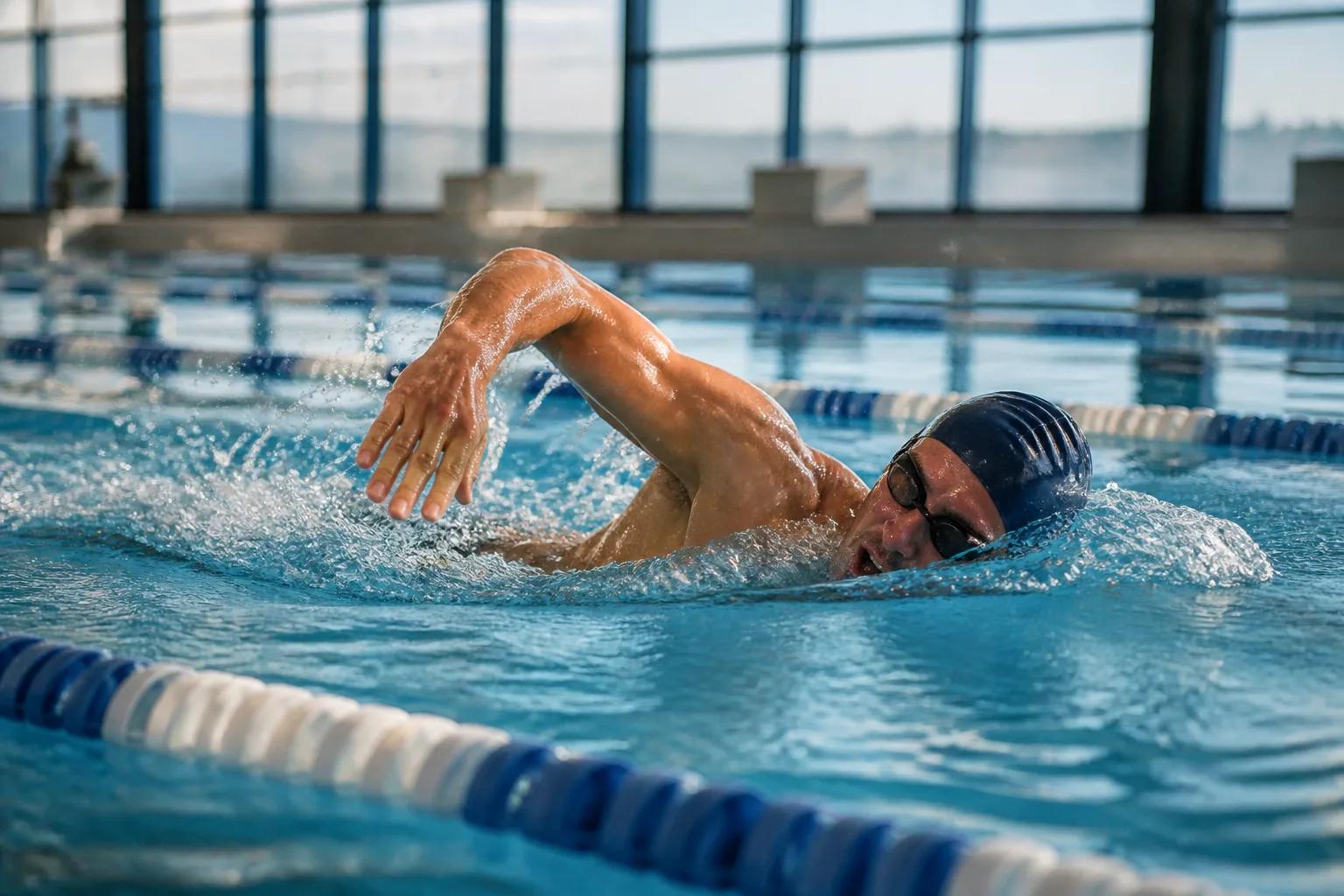
Swimming concentrates very high repetition at the shoulders while the kick and turns add knee, hip and low-back load with almost no impact.
The training year
One steady recovery rhythm
Swimming is usually year-round; recovery changes with yardage, stroke emphasis, hard sets and meet tapers rather than with a universal off-season.
Jan–Dec
Year-round
Lap, club and masters swimming run year-round; meet tapers and open-water events change the load more than the month does.
Protocols for this phase →Wellness and training information, not medical advice. Recovery modalities are a support to good programming, sleep and nutrition — they do not treat, cure, or diagnose injury, and no session guarantees a performance outcome. Pain that persists or worsens deserves evaluation by a clinician or athletic trainer before you train through it.
The demands
What swimming asks of the body
Swimming is low-impact but not low-load. Competitive sessions repeat the same overhead pattern thousands of times, so fatigue accumulates through the rotator cuff, shoulder blade muscles and upper back long before there is visible contact or landing force. Breaststroke adds a distinct knee and hip demand, while starts, turns and dryland work bring short explosive efforts into an otherwise sustained aerobic sport. For lap and fitness swimmers the calendar is usually year-round; the useful planning unit is the hard set, the weekly yardage increase and the meet taper rather than a fixed off-season.
Also known as competitive swimming, lap swimming, pool swimming, open-water swimming, swim training
The load profile
- sustained aerobic output
- high-volume overhead repetition
- rotator cuff and scapular endurance
- kick-driven knee and hip load
- explosive starts and turns
From demands to modalities
What studios pair with this load
The demands above are the input. These are the modalities recovery studios commonly pair with that kind of load — read what each actually does before you book.
The load
- sustained aerobic output
- high-volume overhead repetition
- rotator cuff and scapular endurance
- kick-driven knee and hip load
- explosive starts and turns
What studios pair with it
Compression therapy
Air-pressure compression
Pairs with: sustained aerobic output · kick-driven knee and hip load
What it does →Assisted stretch
Practitioner-assisted stretch
Pairs with: high-volume overhead repetition · kick-driven knee and hip load
What it does →Infrared sauna
Radiant heat therapy
Pairs with: sustained aerobic output
What it does →Float therapy
Quiet float tank
Pairs with: sustained aerobic output
What it does →A reading map, not a prescription — each page explains what a session involves and what the evidence shows. For condition-level evidence, start at the conditions library.
Gear and surface
What changes how the load lands
Two athletes on the same schedule can accumulate very differently depending on what they train on and in.
Paddles and resistance tools increase force per stroke; fins shift more work toward the hips and legs. A wetsuit can restrict shoulder motion in open water, while a sudden equipment change can alter load even when distance stays the same.
What tends to show up
Common complaints, and where to read more
Plain-language descriptions of what athletes in this sport report. Where a cited evidence guide exists, the entry links to it.
Delayed Onset Muscle Soreness
Delayed onset muscle soreness is the one recovery target where the research is genuinely deep, and several modalities do reduce how sore you feel.
See the evidence →Knee Pain
Knee pain is discomfort in or around the knee joint from overuse, arthritis, injury, movement load, or irritation of muscles, tendons, ligaments, or cartilage.
Browse all conditions →Neck Pain / Cervicalgia
Neck pain is pain or stiffness in the cervical spine area, commonly related to muscle strain, posture, stress, arthritis, disc irritation, or nerve irritation.
Browse all conditions →Near you
Find recovery near you
The directory behind Praxium — studios by city and modality. Start where coverage runs deepest, or browse everything.
Questions
Frequently asked questions
Why can shoulders get sore in a sport with no impact?
The load comes from repetition rather than collision. A hard swim week can contain thousands of overhead cycles, and fatigue changes how the shoulder blade and rotator cuff control each stroke. Persistent pain or loss of motion needs assessment, not another recovery session.
Does stroke choice change the recovery picture?
Yes. Freestyle, backstroke and butterfly concentrate load at the shoulder in different positions, while breaststroke adds more knee and hip demand. Ask which strokes and sets dominate the week before treating every swimmer as the same.
Should recovery follow the hardest set or the longest practice?
Usually the session that combines the most yardage with the most demanding stroke or pace. The useful target is protecting the next quality water session; feeling temporarily looser is not evidence that an irritated shoulder is ready for more volume.
Is dryland training part of swimming load?
Absolutely. Pulling, pressing and medicine-ball work sit on top of pool repetition, and a new dryland block can be the reason soreness changes even when yardage stays flat.
Should a painful shoulder be trained through?
Not automatically. Pain that persists between sessions, changes the stroke or reduces strength is an injury question. Recovery modalities can support comfort but do not replace load adjustment or clinical evaluation.
Keep exploring
Conditions referenced
Recovery goals
Guides
The beginner's guide to recovery modalities: what each one does and where to start →How often should you cold plunge? Dose, duration, and when more backfires →Contrast therapy: how to alternate hot and cold, and why the order matters →Red light therapy: what the evidence supports, and what it doesn't →Compression therapy: how pneumatic boots work and what they actually do →PEMF therapy explained: what pulsed magnetic fields can and can't do →Is whole-body cryotherapy worth it? A cost-benefit look →
Turn a season into a plan
Take the 2-minute Modality Match quiz and get a starting point built around how you train — which modalities to look at first, and which to run past a clinician.
Wellness and training information, not medical advice. Recovery modalities do not treat, cure, or diagnose any injury or condition and never replace care from a qualified clinician, athletic trainer, or physical therapist.